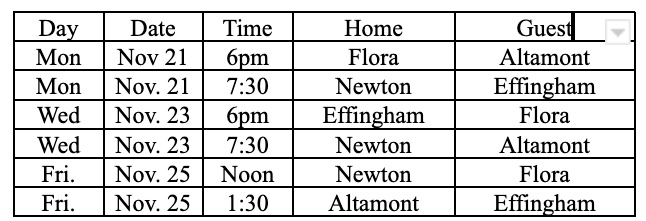
Below is the 2022 Bob Kerans Girls Thanksgiving Basketball Tournament Schedule. Also included are the shot clock rules for the season by IHSA.









Shot Clock
2022-23 season
For the 2022-23 school year, the IHSA Board of Directors has authorized the use of a 35 second shot clock for high school regular season shoot outs and regular season tournaments that wish to use it. The shot clock rule that must be followed is the model rule created by the NFHS Basketball Rules Committee. While the model rule can be found in the current NFHS Basketball Rules Book, this document is intended to provide schools and officials with some insight into the shot clock’s implementation in Illinois.
Shot Clock Displays
- A shot clock is one of the two official visible timepieces – one at each end of the court. 2. Shot clocks should be recessed and mounted on the backboard supports behind each backboard.
- LED lights located around the shot clock may be used, but the lights shall only be activated for a shot clock violation.
- Nothing shall be attached to the shot clock mounting mechanisms that affects the visibility of the shot clock.
Game and Table Officials
A shot clock operator will be located at the scorer’s and timer’s table. It is recommended that the timer and shot clock operator be seated next to each other.
Officials’ General Duties
- Use the shot clock to administer the 10-second backcourt count (9-8). The 10-second count shall begin when the ball touches, or is legally touched by, a player on the court, in the backcourt on a throw-in, or on player control on a rebound or jump ball. Note that this is a different application of the backcourt rule and is ONLY used when the shot clock is in effect. Use a silent, visible 10-
second count when there is no shot clock visible. (NFHS Signal 9)
- To indicate a shot clock violation, the official will give the stop clock signal followed by the tapping of the head and give a directional signal.
- To indicate a shot clock reset, the official will use a rolling motion of a pointed index finger above the head.
General Principles
- Use a 35-second shot clock in accordance with NFHS Basketball Rule 2-14.
- The shot clock shall be used the entire game, including extra periods, except when there is less time remaining on the game clock than on the shot clock. This includes any game where the Mercy Rule goes into effect.
- Control a separate timing device with a horn that shall have a distinct sound different from the game clock horn.
- During the 2022-23 experimental period, any failure of the shot clock to work during a game will result in the remainder of that game being played by conventional timing rules. Events do not need to have their tournament or shoot out delayed if the clock can’t be fixed in a timely manner. 5. Start the shot clock when:
- The ball touches, or is legally touched by, a player on the court;
- A team gains initial control after a jump ball or unsuccessful try for goal;
- There is a change in team control.
- The shot clock shall be stopped and reset to the full amount when the following occur: a. After a change in team control and the ball remains live or after a score by the opponent. NOTE: the mere touching of the ball by an opponent does not start a new shot clock period when the same team remains in control of the ball.
- A single personal foul;
- A single technical foul;
- During team control, a defensive player causes a held ball, and the alternating-possession arrow favors the defensive team;
- When a try for goal strikes the ring or flange and then possession is gained by either team; f. When a violation occurs and the defense is awarded the ball for a throw-in; g. After a held ball or any other situation where the alternating-possession arrow is used to
determine team possession and the alternating-possession arrow favors the defense for the subsequent throw-in;
- After the ball goes out of bounds and was last touched simultaneously by two opponents, both of whom are either inbounds or out of bounds or when there is doubt as to who last touched the ball and the possession arrow favors the defensive team;
- When there is an inadvertent whistle and there was no player or team control at the time of the whistle.
- The shot clock shall be reset but not to full 35-second amount when the following occurs: a. Reset the shot clock to 20 seconds when there is an intentionally kicked or fisted ball with less than 20 seconds on the shot clock.
- In all other cases, no reset to the shot clock shall be made when the timing device is stopped. 9. Allow the shot clock to continue during loose-ball situations when the offense retains control or when a field goal try is attempted at the wrong basket or when a field goal has failed to hit the rim or flange.
- Sound the shot clock horn at the expiration of the shot clock period. This shot clock horn shall not stop play unless recognized by an official’s whistle. When the shot clock indicates zeroes, the shot clock time has expired.
- Turn off the shot clock when a reset situation occurs, and the game clock shows less time than that of a shot clock period.
- Allow the timing device to continue during loose-ball situations when the offense retains control or when a field goal try is attempted at the wrong basket or when a field goal try has failed to hit the rim or flange.
- Allow the game officials to make the final decision when there is doubt as to whether a score was made within the shot clock period or whether a try for goal contacted the ring or flange
Timing Errors
- When an obvious mistake by the shot clock operator has occurred in failing to start, stop, set or reset the shot clock, or when a shot clock has malfunctioned, the mistake or the malfunctioning problem may be corrected in the shot clock period in which it occurred only when the official has definite information relative to the mistake or malfunctioning problem and the time involved.
Shot Clock Violation
- A shot clock period is the period of time beginning when the ball is legally touched on a throw-in or when team control is established or re-established after loss of team control and the shot clock is properly started. The shot clock period ends when the shot clock is properly started for the next shot clock period.
- A shot clock try for field goal is defined as the ball having left the shooter’s hand(s) before the sounding of the shot clock horn and then striking the ring or flange, or entering the basket. 3. The team in control must attempt a try for field goal, within the 35-second shot clock period. 4. It is a violation when a try for field goal does not leave the shooter’s hand before the expiration of the allotted shot clock time (as indicated by the sounding of the shot clock horn) or when it does leave the shooter’s hand before the expiration of the allotted shot clock time and the try does not subsequently strike the ring or flange or enter the basket.